
In Memoriam: Professor Nigel Dunnett (1963–2026) — A Champion for Living Cities
The global green infrastructure community is saddened by the loss of Professor Nigel Dunnett, who passed away on April 26, 2026, at the age of 63. As a visionary horticulturalist, author, and Professor of Planting Design and Urban Horticulture at the University of Sheffield, Nigel’s was one of the world’s most influential voices in redefining the relationship between nature, architecture, and urban planning.
At the Norwegian Association for Green Infrastructure (NFGI), we honor his extraordinary legacy. Nigel did not just design gardens; he pioneered a philosophy that transformed urban spaces into dynamic, climate-resilient, and living ecosystems.
Nigel was actively involved with the Green Infrastructure community, participating in Congresses in London, England (2008) and Nantes, France (2013). To the question, “Why do you think green roofs are important,” Nigel replied, “Because they allow incredible things to be done with planting, vegetation, habitat and biodiversity that just wouldn’t be possible on the ground in the same location – that’s always been the thing that has most excited me. I was really switched on to the possibilities when I first visited the green roof on Chicago City Hall in 2003. My eyes were opened to just what could be achieved – landform, plant communities, beauty, trees – it completely changed my outlook, and spurred me on to my own adventures in green roof planting.”
A Leading Voice for the Green Infrastructure Community of Practice
Nigel Dunnett was central to the transformation of the green infrastructure movement, shifting the global professional focus from sterile, hard landscapes to biodiverse, high-performing “soft” infrastructure. He bridges the gap between rigorous ecological science and breathtaking artistic design, proving that urban greening can be simultaneously wild, functional, and deeply beautiful.
His contributions to our community of practice are monumental:
- A Pioneer of Naturalistic Planting: Alongside his long-time collaborator James Hitchmough, Nigel pioneered ecological, seed-based naturalistic planting. He challenged traditional, high-maintenance landscape management by proving that diverse, low-input plant communities could thrive in harsh urban environments.
- Transforming Public Consciousness: His high-profile masterworks brought the concepts of urban biodiversity and green infrastructure into the global spotlight. From the spectacular, climate-adapted expanses of the Queen Elizabeth Olympic Park to the Tower of London “Superbloom” and the Barbican Beech Gardens, Nigel showed the world what a green city could truly look like.
- Sustainable Urban Drainage (SuDS): Nigel was a fierce advocate for integrating water management into the urban fabric. His work on the Sheffield “Grey to Green” project remains a gold-standard blueprint for how cities can use bioswales and urban vegetation to mitigate flooding while enhancing public life.
- Author: Nigel authored Planting Green Roofs and Living Walls (co-authored with Noël Kingsbury) Dunnett and Kingsbury shifted the narrative on building integrated green infrastructure by arguing that green roofs and living walls should be designed as dynamic, highly biodiverse, and aesthetically pleasing ecological systems. Together with Andy Clayden Nigel co-authored Rain Gardens: Managing Water sustainably in the Garden and Designed Landscape. Following the same philosophical line as his work on green roofs, Nigel revolutionized how landscape architects and garden designers approach urban hydrology. Nigel’s philosophy of landscape and urban design was encapsulated in the seminal The Dynamic Landscape, co-authored with James Hitchmough and launced in its second edition in October, 2025.
- Educator and Innovator: Beyond his books and research papers, he founded the social enterprise Pictorial Meadows, democratizing ecological urban design by making wildflower meadow systems accessible to municipalities worldwide. As an educator, he inspired multiple generations of landscape architects to prioritize ecological integrity.
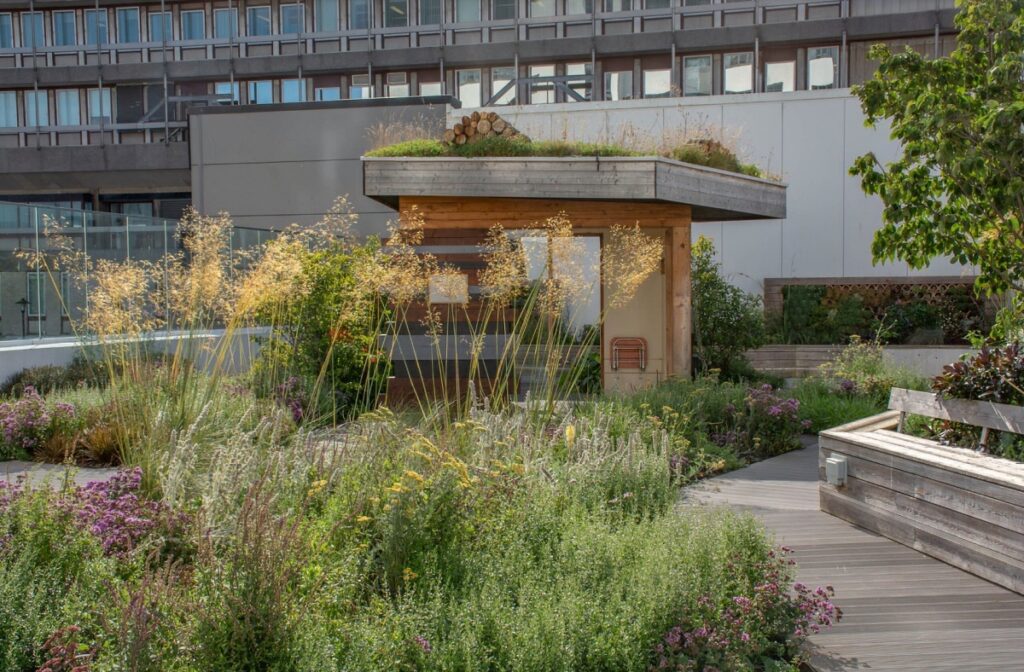
Healing Through Nature: The Aberdeen Royal Infirmary Roof Garden
While Nigel’s grand urban masterplans won international acclaim, my personal favorite of Nigel’s many contributions to our field is the role he played in the creation of The Robertson Family Roof Garden at the Aberdeen Royal Infirmary in Scotland.
The project originated from Nigel’s gold medal-winning RBC Blue Water Roof Garden at the 2013 RHS Chelsea Flower Show. Rather than letting the installation disapear after dismantling, Nigel collaborated with the hospital’s Chaplin James Bell Falconer to adapt the design and installation into a permanent, 24/7 therapeutic sanctuary in the heart of the hospital.
Opened officially by Queen Elizabeth II in 2017, the garden represents a pinnacle of biophilic, inclusive healthcare design. Nigel engineered the rooftop to be entirely accessible, ensuring that even critically ill, fully ventilated patients from the intensive care unit could be wheeled outside to experience the open air, the rustle of grasses, and the scent of trees.
The Aberdeen roof garden stands as a powerful testament to Nigel’s belief that access to nature is not a luxury, but a fundamental human right—and an essential component of clinical recovery and psychological restoration.
A Lasting Legacy
Nigel Dunnett’s work altered the trajectory of modern landscape architecture. He taught us that urban nature should not be merely decorative, but an active, spontaneous, and healing force woven deeply into our buildings and streets.
The Norwegian Association for Green Infrastructure extends our deepest condolences to his wife Marta, sons Alex and Jack, colleagues, and the countless students and professionals he inspired.